The Founding of Holiday Inn
Holiday Inn was founded in 1952 by Memphis businessman Kemmons Wilson, whose vision for standardized, family-friendly roadside lodging reshaped the American hospitality industry. Wilson's inspiration came from a frustrating 1951 family road trip from Memphis to Washington, D.C., during which he and his wife Dorothy and their five children encountered inconsistent, overpriced, and often unsanitary independent motels. Many charged extra for children, offered no reliable amenities, and varied wildly in quality from one stop to the next.
Recognizing that millions of American families must be enduring the same experience as the postwar highway system expanded, Wilson resolved to build a chain of motor hotels that would deliver the same clean, comfortable, and affordable experience at every location. His founding principles were straightforward: children stay free, every property would have a swimming pool and air conditioning, there would be no surprise charges, and the rooms would meet a consistent standard of cleanliness and modern amenities.
"I'm going to build a chain of motels — clean, comfortable, and always the same."
— Kemmons Wilson, 1952
Wilson opened his first Holiday Inn on Summer Avenue in Memphis, Tennessee, in August 1952. Borrowing the name from the 1942 Bing Crosby film Holiday Inn, the property signaled something new on the American roadside: a promise of predictability and family welcome. The success was immediate. Wilson partnered with fellow Memphis builder Wallace E. Johnson, and together they began franchising the concept. By 1958, there were 50 Holiday Inns; by 1968, there were over 1,000 locations worldwide.
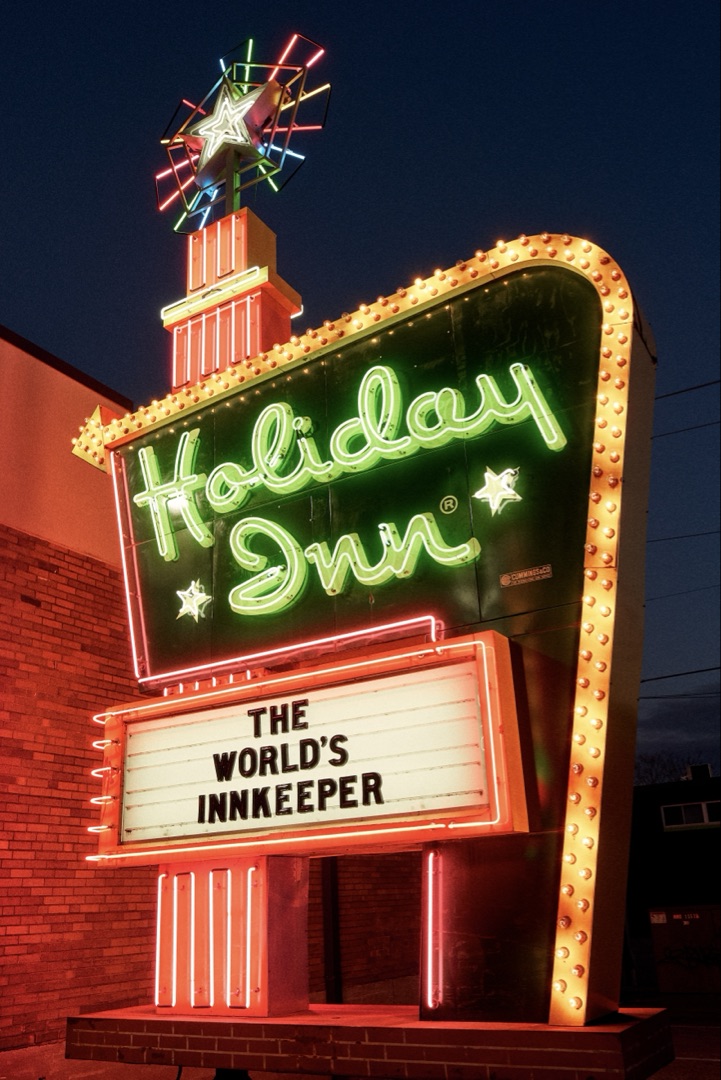
Central to this explosive growth was not just the consistency of the rooms, but the visibility of the brand. Wilson understood that a family driving down a highway at speed needed to spot their destination from a distance, and he wanted something that would signal safety, excitement, and welcome all at once. That need gave birth to one of the most recognizable commercial signs in American history: the Holiday Inn Great Sign.
Balton & Company: The Original Design
When Kemmons Wilson decided he needed a spectacular roadside sign for his new motor hotel, he turned to Balton & Sons Sign Company, a well-established Memphis firm that had been producing commercial signs, billboards, and theater marquees since the late nineteenth century. Balton & Sons had deep expertise in the kind of large-scale, illuminated signage that dominated American commercial districts and movie houses of the era.
Wilson gave Balton a clear creative brief: a sign approximately 50 feet tall, visible from both directions on the highway, with a changeable marquee section for welcoming specific groups or advertising rates. The color scheme was personal — emerald green and yellow, his mother's favorite colors. The overall feel should evoke the excitement and grandeur of a cinema marquee, something that would make travelers feel they were arriving at a destination, not merely pulling into a parking lot.
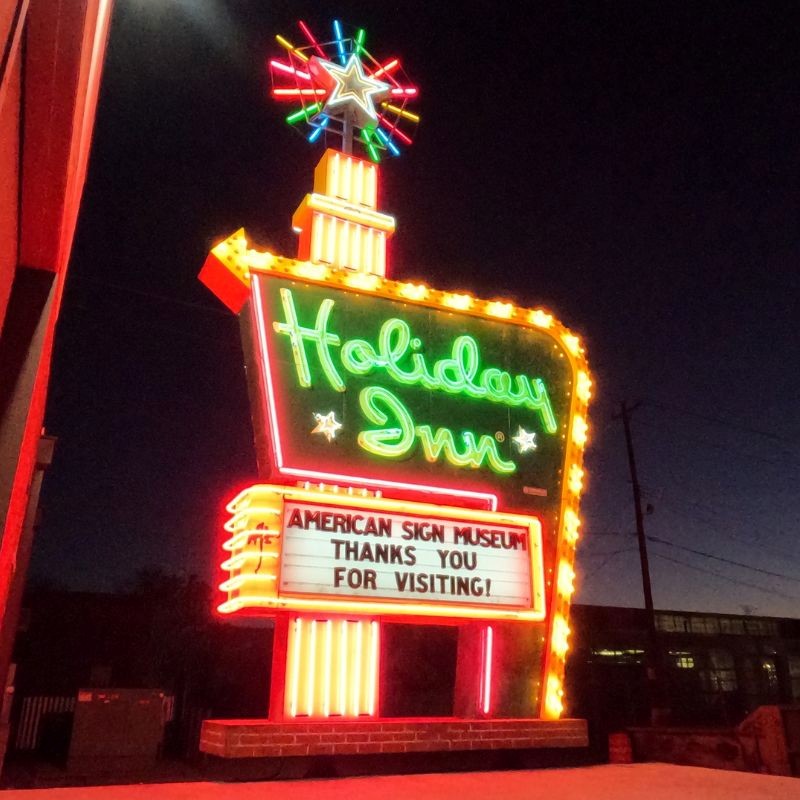
Balton & Sons took this verbal concept and developed it into a complete, buildable design program. The company was responsible not only for the creative artwork but also for the engineering: the steel structural supports, the neon tube routing, the placement of hundreds of incandescent bulbs, and the electrical systems that produced the sign's famous chasing and flashing light effects. Balton's shop converted the artists' drawings into full-size patterns, structural plans, and fabrication specifications.
As Holiday Inn expanded nationally and then internationally, the original Balton design became the template for Great Signs across the entire system. Company histories from Balton successors emphasize that the Memphis firm "designed and produced" the original Great Sign and regard it as one of the most commercially successful sign programs ever created.
Cummings & Company: Manufacturing to Meet the Demand
As Holiday Inn's franchise system expanded at a pace that no single local sign shop could sustain, the company turned to Cummings & Company (also known as Cummings Resources) of Nashville, Tennessee, to serve as the major manufacturer of the Great Sign. Founded in 1946 by Thomas L. Cummings, Jr., the firm had started as a local signage manufacturer, installer, and maintenance provider before expanding its branch operations in the early 1950s to cities across Tennessee and beyond.
Holiday Inn needed a signage partner capable of keeping pace with its aggressive growth along President Eisenhower's expanding interstate highway system. Cummings fit that role precisely. The Nashville company took on the large-scale production of the Great Signs, manufacturing the towering structures that were, as one account described them, "bright as blazes, built to be visible from Dwight Eisenhower's new interstate highway system." Where Balton & Sons had originated the design and produced the earliest signs, Cummings became the manufacturing engine that enabled the Great Sign to appear at hundreds of Holiday Inn locations as the chain spread across the United States and into more than 70 countries.
"Bright as blazes, built to be visible from Dwight Eisenhower's new interstate highway system."
— Contemporary account of the Great Sign
Cummings Resources brought the organizational infrastructure needed for a national rollout. By the early 1950s, the company had already begun building a network of regional operations, and it later formalized this approach by creating the International Sign Service (ISS) — a network of sign installation companies across North America with local installers who could handle on-site assembly and ongoing maintenance. Thomas L. Cummings, Jr. personally flew across the country to recruit and organize these local partners, ensuring that the Great Sign could be erected and serviced reliably regardless of location.
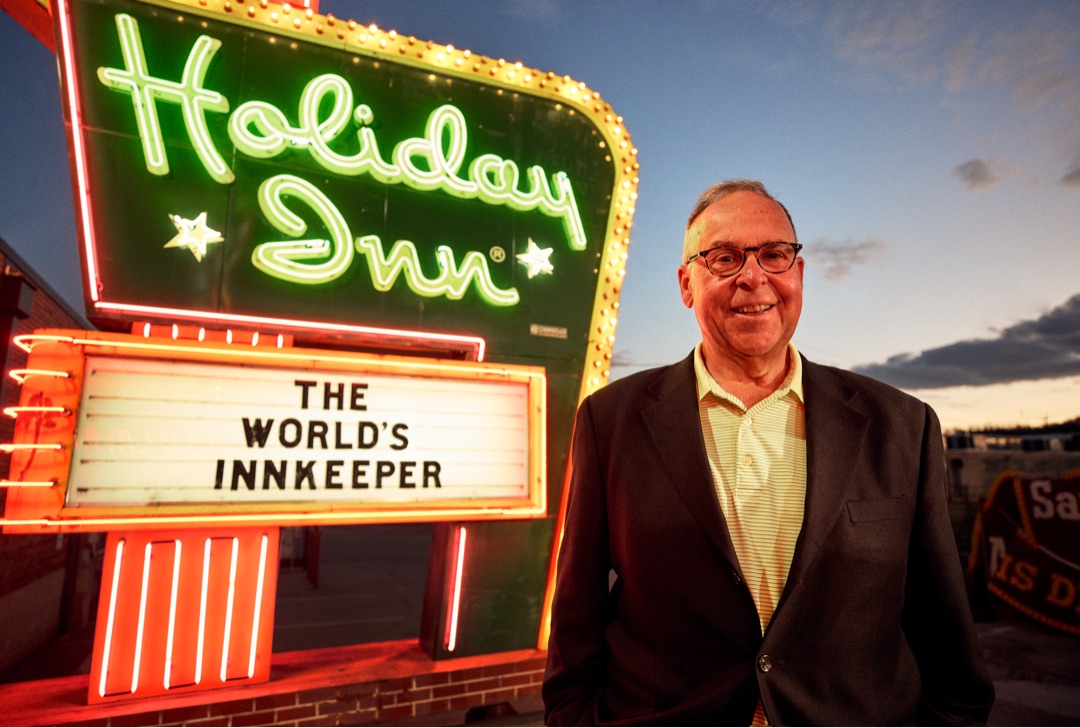
The American Sign Museum identifies Cummings & Co. as "the original manufacturer of the Great Sign," and the museum's restoration of its own Great Sign relied on original Cummings production designs when recreating the signature starburst topper. In 2019, Mike Conway, former CEO of Winegardner & Hammons, Inc. one of the largest franchisees of Holiday Inns — launched a fundraising campaign to commission the star's restoration. "I wanted to see the Holiday Inn Great Sign restored to honor its heritage and to save an American Icon," Conway said. The museum's collection also includes a scale model of the Great Sign built by Cummings, Inc. for Holiday Inn's use at trade shows and promotional events.
The Holiday Inn account helped transform Cummings from a regional sign maker into a national signage provider. The experience of manufacturing and deploying Great Signs at scale led the company to take on other major national clients, including Ford, General Motors, Chrysler, and KFC. Today, Cummings Resources remains headquartered in Nashville and continues to operate as one of the leading national signage providers in the United States.
Gene Barber & Roland Alexander: Designing an American Icon
Within Balton & Sons, sketch artists Gene Barber and Roland Alexander were the principal designers who translated Wilson's verbal instructions into the visual language of the Great Sign. While sources do not break down individual authorship of each element, the pair is jointly credited with creating the complete design composition that Holiday Inn replicated worldwide.
The Towering Structure
A roughly 50-foot pylon deliberately scaled to dominate the roadside skyline, visible at highway speeds from long distances and designed to tower over all competing motel signs.
The Yellow Starburst
A radiating starburst topper in Holiday Inn yellow — the sign's most arresting element at distance, creating an explosion of light that drew the eye before any text could be read.
Emerald Green Field
The large green panel bearing "Holiday Inn" in white neon script — Wilson's mother's favorite color, now synonymous with the brand across six continents.
The Blinking Arrow
A prominent sequencing arrow embellished with bulbs — both a decorative motif and a wayfinding device directing motorists from the highway toward the office entrance.
Theater-Inspired Lighting
Neon tubing and hundreds of incandescent bulbs in chasing patterns — green, yellow, and red fields alive with flashing motion, behaving like a cinema marquee come to life on the highway.
The Changeable Marquee
An internally lit message box with movable letters, allowing each location to display customized messages like "Welcome Shriners" — uniting national brand identity with local hospitality.
A Beacon for Weary Travelers
The emotional power of the Great Sign extended far beyond commercial branding. For millions of American families in the 1950s, 1960s, and 1970s, the sight of the sign's green glow and flashing starburst rising above the highway horizon was a moment of genuine relief and anticipation. It meant the end of a long day's drive, a clean room, a swimming pool for the children, and no unpleasant surprises. The sign functioned as a lighthouse on the American road — a promise of safety and comfort in unfamiliar territory.
The sheer physical scale of the sign — often exceeding 50 feet in height — meant it could be spotted well before any other roadside feature. At night, its combination of neon and incandescent illumination created what observers described as a "supernova" effect, a burst of warm, multicolored light cutting through the darkness. For a family with tired children in the back seat, that glow represented everything they were hoping for: rest, reliability, and the familiar comfort of a brand they trusted.
"Seeing the Holiday Inn sign meant you were on vacation."
— American roadside memory
The sign also carried a layer of aspiration. In the postwar era of expanding highways, rising middle-class mobility, and the democratization of leisure travel, the Great Sign symbolized access — access to comfortable lodging that had once been the province of the wealthy. Holiday Inn made family vacations practical, and the Great Sign was the visual embodiment of that promise.
Phase-Out and Enduring Legacy
In 1982, after Kemmons Wilson had departed the company, Holiday Inn's corporate management made the decision to phase out the Great Signs. The towering neon structures were expensive to build, install, and maintain, and the company was modernizing its image with sleeker, cheaper backlit plastic signage. Wilson reportedly called the decision the company's "worst mistake" and, in a widely noted gesture, had a replica of the Great Sign engraved on his tombstone.
Most of the original Great Signs were dismantled and scrapped. Today, only a handful of surviving examples remain. The most prominent is the fully restored Great Sign at the American Sign Museum in Cincinnati, Ohio, acquired in 2002 and painstakingly restored to full working order — complete with a recreated starburst topper based on original Cummings & Co. production designs and 836 feet of neon tubing. The restoration required 31 transformers and 450 light bulbs; the completed sign weighs approximately 14,000 pounds. The Henry Ford Museum in Dearborn, Michigan, also displays a circa-1960 example, and a privately held sign is preserved in Park Hills, Kentucky.
These surviving signs are now treated as artifacts of American cultural and design history. They represent not only the golden age of roadside signage and neon craftsmanship, but a specific moment in the American experience when the open road, the family car, and a trusted green glow on the horizon defined how a nation traveled. The work of Gene Barber and Roland Alexander at Balton & Sons, manufactured at scale by Cummings & Company, produced far more than a commercial sign — they created an enduring symbol of mid-century American optimism, mobility, and hospitality.
Sources
- The Henry Ford — Holiday Inn Sign artifact page
- American Sign Museum — Holiday Inn Great Sign Restoration
- Kemmons Wilson Companies — Our History
- Memphis Heritage Inc. — Holiday Inn Sign Heritage
- IHG — Holiday Inn Brand History
- Cummings Signs — A History of the 75-Year-Old Startup
- Andrew Nelson, "The Holiday Inn Sign," Salon, 2002
- Signs of the Times — American Sign Museum Restores Great Sign
- American Sign Museum — Holiday Inn Great Sign Scale Model (Cummings, Inc.)